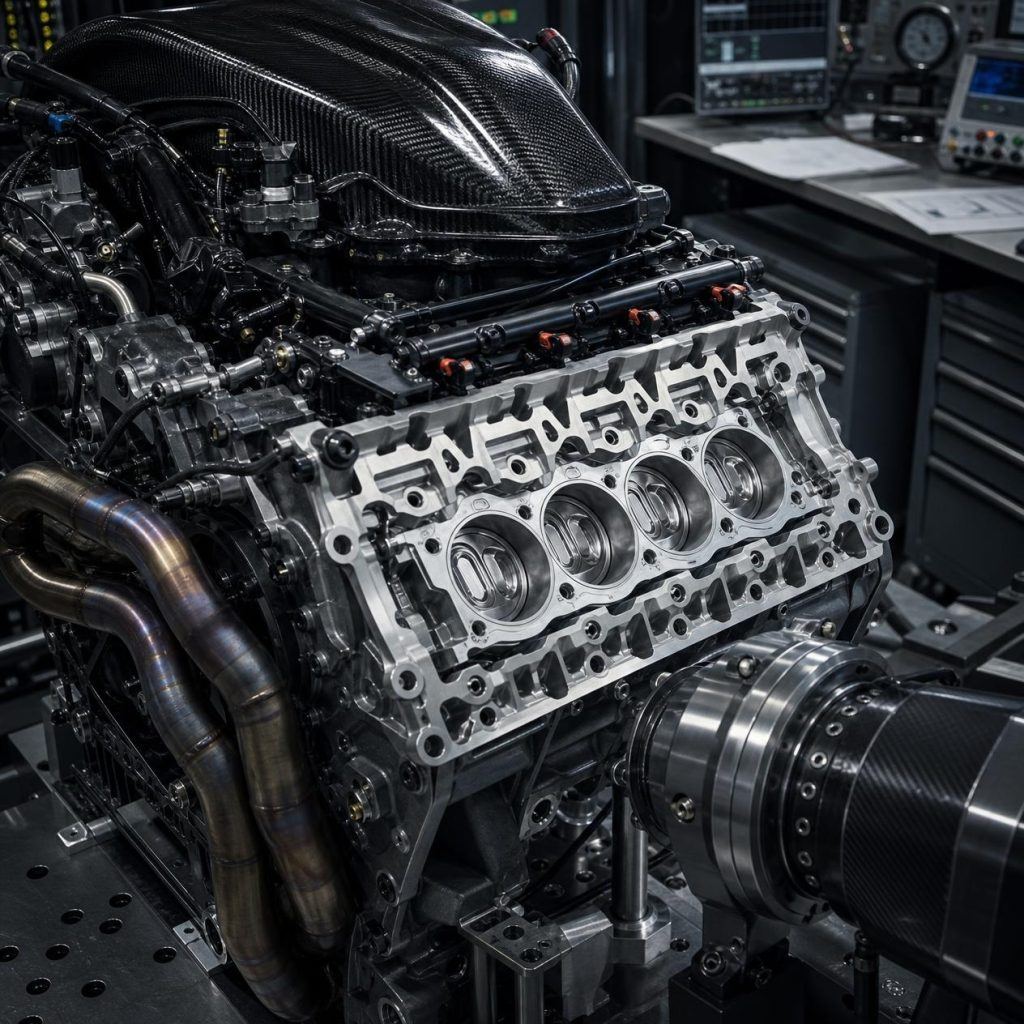





In Formula 1, championships can be won or lost on the interpretation of technical regulations. The same principle often applies to patents, where the scope and value of protection depend not only on the underlying innovation, but on how that innovation is described and claimed.
The sport’s news cycle was dominated earlier this year by a controversial interpretation of Formula 1’s new for 2026 power-unit regulations. While the debate centred on engine design, it also offers a useful lesson for founders and start-ups seeking to protect innovation through patents.
A question of interpretation
The controversy concerned the maximum compression ratio permitted in an engine cylinder. The regulations specify a limit of 16:1, with compliance assessed at ambient temperature. Pre-season reports suggested that one or more manufacturers had developed engine designs capable of satisfying the prescribed test while exhibiting different characteristics once operating at race temperatures, resulting in higher power output.
Whether any particular manufacturer obtained a competitive advantage remained a matter of industry speculation. The broader issue, however, was clear. The regulations established a limit, but they also prescribed the conditions under which that limit would be measured. Those two concepts were not necessarily identical.
Innovation is protected through language
The issue illustrates a principle that extends well beyond motorsport: technical requirements are only as effective as the language used to define them and the assumptions that underpin them. Small differences in wording can significantly influence how a technical requirement is interpreted and applied.
Many founders think primarily in terms of products, technologies and commercial opportunities. The patent system, however, operates through language. Protection is not determined by what an inventor intended to claim, nor by the importance of the underlying idea. It is determined by what is disclosed in the patent specification and how the invention is defined in the claims.
This creates an important challenge, particularly during the early stages of product development. When preparing a patent application, it is natural to focus on the product that currently exists. A founder typically knows every component, every feature and every engineering decision that contributed to the prototype or first commercial version.
The difficulty is that the product itself is not always the invention. A patent specification that focuses too closely on a particular implementation can limit the breadth of claims that can ultimately be supported, thereby unintendedly narrowing the possible future scope of protection.
The view from the other side
If a patent specification is drafted too closely around an inventor’s preferred implementation, a competitor may be able to capture much of the same value through relatively minor technical changes.
This is why competitors often read patents very differently from inventors. Inventors tend to read a patent with an understanding of what they created and why it matters. A competitor will not ask what the inventor hoped to protect. It will ask what the claims actually require.
If a claim requires a particular combination of technical features, a competing product that achieves a similar outcome by changing one of those features may fall outside the scope of protection. The commercial outcome may be similar, but the legal outcome may be very different.
In many respects, this mirrors the way Formula 1 engineers examine technical regulations. Their objective is not necessarily to challenge the rule itself, but to understand exactly where the boundary lies and whether alternative routes exist to achieve the same result.
Precision is more than specificity
While technical disclosure is essential, effective patent drafting also requires consideration of future developments, alternative implementations and potential design-around strategies. A patent specification may describe a founder’s product with complete technical accuracy and yet still provide competitors with opportunities to achieve the same commercial result through alternative approaches.
Conversely, broad protection cannot simply be achieved by removing technical detail. Any claim scope sought must remain supported by the disclosure and satisfy the relevant legal requirements.
The objective is therefore not simply to write more or less. It is to describe the invention in a manner that supports commercially meaningful protection. Achieving that balance requires careful consideration of which features are fundamental, which are optional, and how the technology may develop over time. These are strategic questions as much as technical ones. For this reason, patent drafting is far more than a technical writing exercise.
Looking beyond the filing date
The importance of these decisions is reinforced by the role of the original patent specification. In Australia and New Zealand, as in many other jurisdictions, there are significant restrictions on adding new technical subject matter after the patent specification is first filed. Deficiencies in the original specification may therefore be difficult, and sometimes impossible, to correct later.
This reality is particularly relevant for founders and start-ups operating in fast-moving technology sectors. A patent application may be filed when the technology is still evolving, and the commercial opportunity remains uncertain. Years later, the company may have launched multiple product generations, entered new markets or attracted substantial investment. By that stage, the patent may have become one of the company’s most valuable assets. However, the scope of protection ultimately obtained will often depend heavily on the quality and breadth of the original disclosure.
Many founders understandably focus on securing a filing date. However, the long-term value of a patent often depends on strategic decisions made before the application is ever lodged. Experienced patent attorneys focus not only on what an invention is today, but also on what it could become tomorrow. Professional patent drafting typically involves exploring alternative embodiments, identifying fallback positions and considering how competitors might seek to achieve similar outcomes through different technical approaches.
Lessons from the racetrack
The Formula 1 compression-ratio debate illustrates how alternative interpretations of technical language can produce outcomes that differ from those originally intended. Patent specifications invite a similar inquiry. Will the specification continue to support the inventor’s strategic and commercial objectives when scrutinised by competitors, investors, patent offices and courts, often years after the original filing date?
For founders and start-ups, this question is often more important than whether an application has merely been filed, or even whether a patent has ultimately been granted. A strong patent specification does more than record a product as it exists on the filing date. It identifies the broader inventive contribution, anticipates how others may respond to it, and provides a foundation for meaningful protection as the business grows.
That is why many successful innovators seek professional patent advice at an early stage. The objective is not merely to prepare a document for filing, but to ensure that the innovation is framed in a way that supports its future value. Small drafting decisions can have consequences long after the engineering work is complete.